

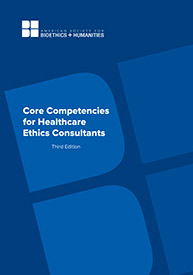
How Core Competencies for Healthcare Ethics Consultation Supports Process Development, Training, and Continuous Improvement
As clinical ethics consultation services grow and mature, the work changes. Consults become more frequent. Cases become more complex. Engagement becomes more longitudinal. With that growth comes a new set of questions, not just about what ethics consultants do, but how they do it, how consistently, and how quality is assessed over time.
For Sabrina Derrington, MD, MA, HEC-C, Core Competencies for Healthcare Ethics Consultation has become a central resource for navigating that evolution by supporting quality improvement, professionalization, and structured training within a growing ethics consultation service.
The Situation: Growth Brings New Questions
After establishing a dedicated clinical ethics consultation service separate from the hospital’s Ethics Resource Committee, Dr. Derrington and her colleagues began to see steady growth in consult volume. Consults were no longer isolated encounters; many involved ongoing engagement with teams and families over time.
With that shift came important operational questions:
- When is the right time to write a consult note?
- How should follow‑up with teams be handled?
- How can the service ensure consistency across consultants and cases?
Rather than relying on individual judgment alone, the team wanted a way to step back and evaluate their work more systematically.
Using Core Competencies as a Quality Improvement Framework
Dr. Derrington’s team turned to Core Competencies not just as guidance, but as a framework for internal quality improvement. “We’re using the Core Competencies to ground our internal QI process,” Dr. Derrington explained, describing how the team now reviews cases and audits their work to ensure alignment with best practices.
In particular, the quality metrics outlined in Chapter 3, specifically Table 4, which addresses quality indicators for ethics consultation services, played a key role. While the team had already developed evaluation tools, the metrics in the book helped them refine and strengthen those assessments to better capture what matters most in ethics consultation. Rather than starting from scratch, the book allowed the team to evolve existing processes using nationally recognized standards.
Building Consistent Processes and Clear Boundaries
Beyond quality measurement, the Core Competencies helped her team bring greater structure and consistency to daily practice. Chapter 3, which focuses on ethics consultation service structure and processes, provided guidance as the team developed templates, clarified expectations, and standardized how consults unfold. This included practical guidance on documentation, follow‑up, and the roles of different stakeholders.
The book also proved useful in navigating boundary questions, particularly the relationship between ethics consultation, legal counsel, and risk management. Written guidance helped the team clarify roles and maintain appropriate distinctions in complex cases involving multiple institutional partners.
Professionalization Through Training and Shared Standards
For Dr. Derrington, the value of Core Competencies extends well beyond operations. She sees the book as a cornerstone of professionalization, helping shift ethics consultation away from variability and toward clearly articulated expectations.
Having defined competencies supports movement away from ethics work that depends heavily on a single individual or informal volunteer roles. Instead, it reinforces the importance of structure, protected time, training, and shared accountability.
Chapter 2, which outlines core skills and attributes, has been especially valuable for mentoring and teaching. The information serves as a framing tool that articulates the goals the team is working toward and the standards they hold one another accountable to. By naming skills explicitly (Table 2), the book helps reduce bias, clarify expectations, and ensure consult requests are evaluated consistently rather than filtered through one person’s lens.
Supporting Training and Broader Ethics Work
As the ethics consultation service grows, Sabrina’s team is also exploring the development of an ethics liaison or champion program. In that context, Core Competencies will become a foundation for curriculum development, helping structure educational content and align it with best practices. In this way, the book supports not only consultation quality, but also broader ethics education and institutional awareness.
The Value: Ethics Consultation as Continuous Practice Improvement
Taken together, these uses highlight the book’s role as a living resource, one that supports reflection, growth, and continuous improvement. As Dr. Derrington noted, the Core Competencies for Healthcare Ethics Consultation helps to ensure ethics consultation evolves alongside the service itself, rather than remaining static. By grounding practice in shared standards, the book supports quality, consistency, and credibility while creating space for consultation services to grow thoughtfully over time.
About Sabrina Derrington, MD, MA, HEC
 Sabrina Derrington, MD, MA, HEC‑C, is Director of the Center for Bioethics at Children’s Hospital Los Angeles and Associate Professor of Clinical Pediatrics at the Keck School of Medicine of USC. A board‑certified pediatric intensivist and certified healthcare ethics consultant, her clinical ethics work focuses on consultation and preventive ethics, ethics education, and ethics program development, with particular expertise in pediatric ethics, shared decision‑making, and intercultural relational ethics.
« Return to the Core Competencies for Healthcare Ethics Consultants page