

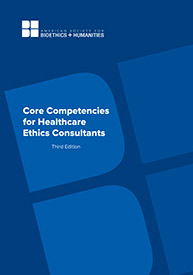
How Core Competencies for Healthcare Ethics Consultation Supports Consistency, Training, and Growth
For health systems with rapidly growing clinical ethics services, success depends on more than good intentions or individual expertise. It depends on consistency—across people, sites, and situations. For Dr. Ruchika Mishra, System Director for Bioethics at Sutter Health, Core Competencies for Healthcare Ethics Consultation plays a central role in outlining the core knowledge, skills, and attributes for healthcare ethics consultants.
Dr. Mishra leads a system‑level ethics program that includes a growing team of clinical ethicists and fellows providing services across multiple hospitals. Ethics committees exist at each site, but the program is designed so that professionally trained ethicists perform the majority of ethics consultations, while committees are utilized for specific types of complex consults as well as policy and organizational ethics issues. , As the program expanded, the challenge was not simply adding staff, it was ensuring that clinical ethicists demonstrated the fundamental competencies required to perform quality ethics work and meet the program’s goals across multiple sites.
The Situation: Growth Demands Trained Workforce and Standards
As she described, hiring qualified clinical ethicists is challenging due to the labor market for this profession and time‑intensive. Fellowship training programs for clinical ethicists currently lack standards. At the same time, ethics committees, essential partners in ethics infrastructure, vary widely in experience and familiarity with best practices.
Without clearly articulated standards, ethics programs risk fragmentation. Practices can drift. Expectations may differ from site to site. And as programs scale, those inconsistencies become harder to manage.
To meet the growing needs, Dr. Mishra discussed the program’s commitment to developing a skilled and credible clinical ethics workforce through their fellowship training program.
Why Core Competencies Became Program Infrastructure
Rather than treating the Core Competencies book as supplemental reading, Dr. Mishra integrated it into the very structure of the fellowship training program. The book became the shared reference point for defining professional expectations—from training and assessment to daily practice.
She emphasized that the third edition’s shift toward practitioner standards was especially important. By focusing on what ethical competence looks like in the individual consultant, the book aligned well with the program’s training goals.
Within the system:
- Fellows are assessed against the Core Competencies from the start of training
- Progress is measured using the book as a milestone framework
- The training program is designed to ensure that fellows develop the knowledge, skills, and professional attributes required for independent practice.
The tables summarizing core knowledge, process skills, and interpersonal skills are used frequently, making the standards accessible for the fellows rather than abstract.
Outcomes: Clarity, Consistency, and Readiness for Practice
Given the lack of training standards for clinical ethics fellowship programs, anchoring fellowship training in the Core Competencies has produced several outcomes:
- Fellows graduate with a clear understanding of professional expectations for clinical ethicists
- Supervisors share a common evaluative framework, reducing subjectivity
- Fellowship training remains consistent even as faculty change
- Leadership can confidently articulate how fellows meet nationally recognized standards for clinical ethicists upon graduation.
Importantly, fellows complete training prepared not only to participate in ethics consultations, but to lead them with appropriate rigor, professionalism, and accountability.
The Value: Scalability Without Compromise
For Dr. Mishra, the Core Competencies for Healthcare Ethics Consultation provide essential infrastructure for training future clinical ethicists. By embedding the competencies directly into fellowship structure, supervision, and assessment, the program ensures scalability without compromising quality. This approach demonstrates how competency-based standards can be translated into concrete educational practice - supporting fellow development, strengthening professional credibility, and contributing to the long-term sustainability of clinical ethics services across diverse healthcare settings.
Additionally, the value of Core Competencies for Healthcare Ethics Consultation extends well beyond large, well‑resourced ethics programs. While the book enables programs at complex health systems to grow with quality, it is equally effective as a standard‑setting resource for individuals, ethics committees working in small team models on consultations, and organizations at many different stages of development.
By shifting its focus from the consultation itself to the expectations of healthcare ethics consultants, the third edition speaks directly to those doing the work, regardless of the size or structure of their program. In doing so, it establishes shared expectations for clinical ethics practice across the field.
Dr. Mishra emphasized that standards matter precisely because not every setting has the capacity to build a fully staffed ethics service. The Core Competencies provide a common point of reference, allowing individuals and committees to assess competence, guide professional development, and align their work with nationally recognized expectations.
The book’s practical design makes this possible. Its tables summarizing core knowledge, process skills, and interpersonal attributes are intentionally digestible and skill‑based, offering rigor without making ethics work feel unattainable. As a result, the book functions both as infrastructure for training programs, large systems and as an entry point for smaller programs, supporting training, consistency, and growth wherever healthcare ethics consultation is taking place.
About Ruchika Mishra, PhD
 Ruchika Mishra, PhD, is System Director for Bioethics at Sutter Health, where she leads a system‑level clinical ethics program supporting hospitals across the organization. Her work focuses on clinical ethics consultation, ethics program development, and fellowship training, with particular emphasis on setting professional standards, building clinical ethics workforce capacity, and aligning ethics practice across complex healthcare systems. She serves on multiple Boards, including the American Society for Bioethics and Humanities (ASBH) and COPACET (Council on Program Accreditation for Clinical Ethicist Training).
« Return to the Core Competencies for Healthcare Ethics Consultants page