

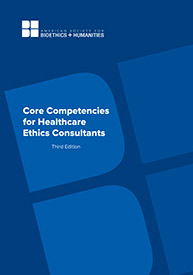
How Core Competencies for Healthcare Ethics Consultation Serves as a Shared Playbook Across Experience Levels and Settings
Clinical ethics work rarely happens in isolation. It unfolds across committees, consultation services, classrooms, and hospital systems—often involving people with very different levels of training, experience, and institutional support. For Valerie Satkoske, PhD, MSW, HEC-C, one of the enduring challenges of the field has been creating coherence across that diversity.
Over the course of her ethics work, she has seen how Core Competencies for Healthcare Ethics Consultation functions as more than a reference text. Instead, it operates as a shared playbook—one that helps create consistency in practice, fosters a sense of community across ethics roles, and remains relevant even for experienced ethics consultants.
The Situation: Ethics Work Without a Common Frame
Dr. Satkoske has worked with ethics committees and services that span a wide range of contexts—from well‑resourced systems to smaller facilities where ethics responsibilities may fall to a single individual with little formal training. What unites these environments is not uniform structure, but a shared need for guidance. People want to do ethics work well, yet often lack clarity around basic questions:
- What should an ethics consultation look like?
- What knowledge is essential, and what expertise can be distributed across a team?
- How should ethics work be documented or communicated?
As Dr. Satkoske put it, people need “a one‑stop kind of shop”—a guidebook that can help them set up best practices and understand what ethical competence really entails. Without that common reference, ethics practice can become fragmented. Each committee or consultant develops their own approach. Language diverges. Expectations vary—not only between institutions, but even within the same system.
Why Core Competencies Becomes the Shared Blueprint
The power of the Core Competencies book lies in its breadth and practicality. It brings together guidance on committee structure, consultation processes, documentation, and core knowledge in a single place—making it usable for both newcomers and experienced consultants.”
Importantly, the book does not assume everyone must hold the same expertise. Instead, it helps teams think intentionally about how competencies are distributed—what every committee member should know, and where deeper expertise may sit with one or two individuals. “Core Competencies is a foundational tool,” she explain, “something people can use to say, These are our functions. This is what we should be doing. This is the kind of representation we need.”
By grounding ethics work in shared competencies, the book lends consistency across people with different backgrounds, training levels, and institutional roles.
Expanding Awareness: Ethics as More Than Consultation
One of the most significant shifts Valerie sees in the third edition of Core Competencies is its expanded view of ethics work. Rather than treating ethics as a narrow function limited to formal consultations, the book acknowledges the broader roles ethics often plays within organizations.
For institutions with low consult volume—or limited formal ethics services—the book affirms that ethics work may include:
- Moral support
- Responding to moral distress
- Increasing ethical awareness across the organization
- Building what Valerie describes as a “moral community”
This expanded framing matters. It validates work that is already happening and helps organizations imagine how ethics can contribute beyond individual cases.
Consistency at Scale: Speaking the Same Language
Dr. Satkoske has also seen how the book supports consistency across hospital systems. When committees and services use the same blueprint, they no longer need to reinvent the wheel. Language becomes shared. Expectations align. Documentation and consultation processes look familiar from one site to the next.
She notes that the language within Core Competencies has become foundational across the field—often echoed verbatim on ethics consultation websites and institutional policies. This shared vocabulary reinforces credibility and makes ethics work more accessible to clinicians and administrators alike.
Why the Book Still Matters for Experienced Ethicists
Notably, Dr. Satkoske emphasizes that the value of Core Competencies does not diminish with experience. Even seasoned ethics consultants continue to return to the book—not because it is rudimentary, but because its guidance deepens over time.
“There are things in the book that I’ve come to understand differently over time,” she reflected. “You can grow with the material.”
For experienced ethicists, the book offers a way to step back, reassess assumptions, and stay grounded in shared standards—particularly when working in isolation or without a strong professional network. It reminds practitioners that ethics work is not static, and that revisiting foundational competencies can strengthen practice rather than limit it.
The Value: A Shared Ethos for the Field
Taken together, these uses point to a larger value. Core Competencies for Healthcare Ethics Consultation does not simply instruct—it connects. It creates a shared awareness of what ethics work involves and why it matters, across settings and experience levels.
By offering common guidance, flexible enough to adapt to local contexts yet rigorous enough to set standards, the book helps build coherence in a field that often operates across silos.
About Valerie Satkoske, PhD, MSW, HEC‑C
 Valerie Satkoske, PhD, MSW, HEC‑C, is Vice President of Ethics at UPMC Mercy Hospital and serves in system‑level ethics leadership roles across UPMC. A certified healthcare ethics consultant and licensed social worker, her work focuses on clinical ethics consultation, ethics program development, and ethics education, with particular emphasis on creating consistent, high‑quality ethics practices across healthcare systems and communities.
« Return to the Core Competencies for Healthcare Ethics Consultants page