

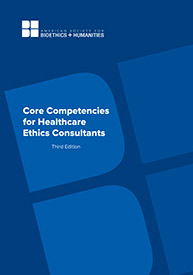
How Core Competencies for Healthcare Ethics Consultation Helps Committees Move from Uncertainty to Practice
Ethics committees are often composed of thoughtful, motivated professionals who care deeply about patients, families, and colleagues. What many committees lack is not commitment—but a shared, practical understanding of what it means to do ethics well.
For Ryan Pferdehirt, Vice President of Ethics Services at the Center for Practical Bioethics, this gap is familiar. Through his work supporting ethics committees across more than 25 hospital systems, Ryan regularly encounters committees that are sincerely engaged yet uncertain about how to translate concern into ethical analysis and action. It is in precisely these moments that Core Competencies for Healthcare Ethics Consultation becomes essential.
From Ryan’s perspective, the book functions less as a reference text and more as a grounding framework, one that helps ethics committees clarify expectations, build confidence, and approach ethics as skilled professional practice rather than improvisation.
The Situation: Willing Committees, Uneven Confidence
In many of the hospitals he works with, ethics committees are made up of clinicians, nurses, social workers, chaplains, and administrators. Ethics work is important—but it is rarely anyone’s primary role.
As Ryan explains, “A lot of people who are doing ethics work don’t think of themselves as ethicists.” Yet when conflict arises, disagreements between care teams and families, uncertainty about values or goals of care, these same individuals are expected to step forward and help.
Without a shared standard, committee members often rely on personal experience, intuition, or strong interpersonal skills. While these strengths matter, they do not always translate into clear ethical analysis or recommendations. Ethics discussions may become narrative‑driven or emotionally focused, leaving committee members unsure whether they are offering real guidance or simply support.
Ryan saw that what committees needed was not more passion or goodwill. They needed clarity about what ethical competence actually looks like.
Enter Core Competencies: Making Ethics Practical and Visible
Committees use the book in multiple ways:
- As foundational reading for new committee members
- As a guide for committee chairs setting expectations
- As a self‑assessment tool that helps members identify where they are strong—and where they need support
When Ryan introduces Core Competencies to ethics committees, he does so intentionally. Rather than framing ethics as abstract or philosophical, the book names ethics as a body of professional skills—skills that can be learned, practiced, and strengthened.
“Core Competencies gives people something concrete,” he noted. “It helps move ethics from opinion‑based to professional. This is what we’re working toward.”
Committees use the book in multiple ways:
- As foundational reading for new committee members
- As a guide for committee chairs setting expectations
- As a self‑assessment tool that helps members identify where they are strong—and where they need support
By clearly outlining core knowledge, process skills, and interpersonal skills, the book helps demystify ethics work. Committee members can see that ethics is not about having the “right answer,” but about engaging thoughtfully and consistently using recognized competencies.
What Changes When Committees Share a Framework
Once committees begin working from the Core Competencies’ framework, Ryan sees a noticeable shift—not just in how meetings run, but in how people show up. Members participate more actively because they understand their role. Discussions move more quickly toward ethical analysis. And committees become more comfortable offering guidance, rather than hesitating at the edges of difficult decisions.
“People feel more comfortable. They feel more confident,” Ryan observed. “They’re more willing to participate because they can see how their skills fit into ethics.”
In some organizations, engagement with the book leads to tangible changes: required ethics training, annual education tied to competencies, and clearer expectations for committee service. The book becomes a shared touchstone—not something read once, but something returned to as questions arise.
The Value: Professionalism Without Exclusion
For Ryan, one of the book’s most important contributions is that it raises the standard for ethics work without alienating those who are not formally trained ethicists.
Many committees discover that they are already strong in areas like communication and facilitation—but weaker in ethical reasoning. Core Competencies makes those distinctions visible and actionable, helping committees focus effort where it is most needed.
As Ryan put it, “Doing ethics well isn’t about having the right opinion. It’s about having the right skills.” By naming those skills explicitly, the book helps ethics committees work more consistently, credibly, and confidently, especially in organizations without full‑time ethics staff.
About Ryan Pferdehirt, D.Bioethics, HEC‑C
 Ryan Pferdehirt, D.Bioethics, HEC‑C, is Vice President of Ethics Services and Rosemary Flanigan Chair in Bioethics at the Center for Practical Bioethics. A certified healthcare ethics consultant, his work focuses on supporting healthcare organizations in developing effective ethics committees, strengthening ethics consultation services, and building practical skills and confidence among professionals engaged in ethics work across a wide range of clinical settings.
« Return to the Core Competencies for Healthcare Ethics Consultants page